

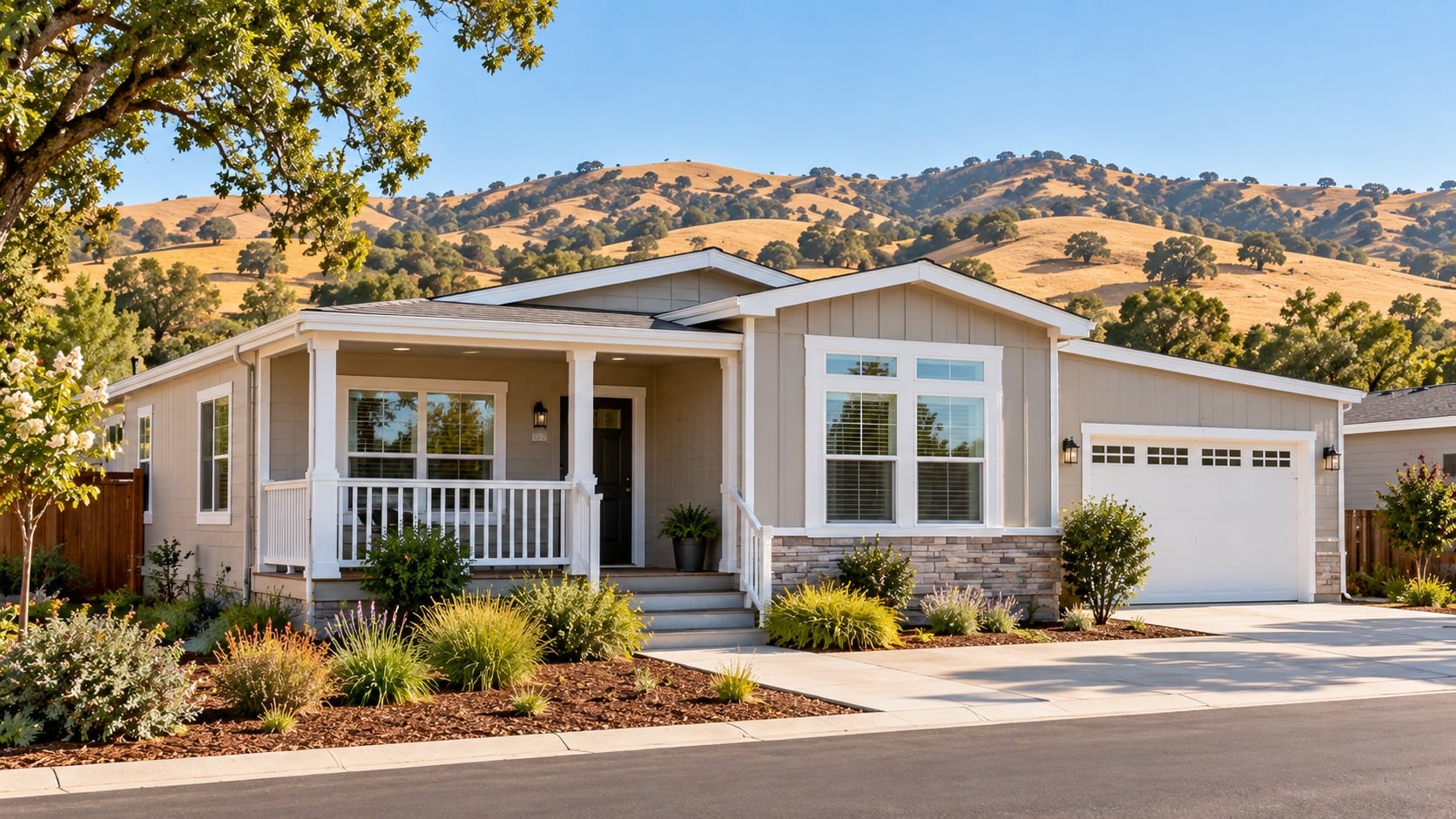
Yes, you can finance a manufactured home in Lincoln, California, using certain FHA, conventional, and other mortgage programs, provided both the borrower and the property meet applicable eligibility requirements.
However, manufactured home financing works differently from financing a traditional site-built house.
A borrower may have excellent credit, consistent income, and sufficient savings, yet still encounter financing problems because of the home’s foundation, construction date, legal classification, or documentation.
That distinction is important for buyers exploring manufactured housing in Lincoln and the surrounding Placer County communities.
Manufactured homes can offer an alternative to traditional construction. Some feature spacious floor plans, updated kitchens, energy-efficient systems, and modern exterior finishes that make them difficult to distinguish from site-built properties.
But appearances alone do not determine mortgage eligibility.
Lenders must establish that the manufactured home satisfies applicable construction standards, meets the requirements of the selected mortgage program, and provides acceptable collateral for the loan.
For buyers considering manufactured home financing in Lincoln, CA, understanding these requirements before making an offer can help prevent unexpected delays and unnecessary expenses.
This guide explains the available financing programs, property requirements, California documentation, and practical considerations involved in purchasing a manufactured home in 2026.
Manufactured Homes vs. Mobile Homes vs. Modular Homes
Before comparing mortgage programs, it helps to understand the differences between three housing categories that buyers frequently confuse.
Although the terms are sometimes used interchangeably, they have different meanings under federal construction standards and mortgage guidelines.
What is a manufactured home?
A manufactured home is constructed in a factory according to federal manufactured housing construction and safety standards administered by the U.S. Department of Housing and Urban Development.
These federal standards became effective on June 15, 1976.
Manufactured homes are built on permanent steel chassis and transported to their installation locations.
They may consist of a single section or multiple sections assembled together at the property.
For traditional mortgage financing, the home generally must be permanently installed and meet additional property eligibility requirements.
The permanent chassis remains part of the manufactured home’s construction, even when transportation components are removed.
What is a mobile home?
The term mobile home commonly refers to factory-built housing constructed before the federal HUD standards took effect.
This distinction matters because homes manufactured before June 15, 1976, generally do not qualify for standard FHA Title II or Fannie Mae manufactured housing financing.
A home might have been renovated extensively, placed on a permanent foundation, or updated with modern appliances.
Those improvements do not automatically overcome the original construction-date requirement.
Buyers should verify the actual manufacture date rather than rely exclusively on the terminology used in a real estate listing.
What is a modular home?
A modular home is also constructed in sections, but it typically follows the applicable state and local building codes rather than the federal HUD manufactured housing code.
Once installed, an eligible modular home may be financed under mortgage guidelines similar to those used for traditional site-built houses.
Fannie Mae specifically distinguishes qualifying modular, prefabricated, and panelized housing from manufactured housing.
This difference can affect appraisal procedures, lending guidelines, and available mortgage products.
For buyers comparing properties in Lincoln, identifying the construction category is an important first step.
What Mortgage Programs Finance Manufactured Homes?
Several mortgage programs may finance qualifying manufactured homes.
The available options depend on the borrower’s financial profile, whether the land is owned or leased, and the home’s physical and legal characteristics.
| Financing program | General financing considerations |
|---|---|
| FHA Title II | Manufactured home and qualifying land or site financed under an FHA-insured mortgage |
| FHA Title I | May finance the manufactured home, the lot, or both, subject to program requirements |
| Conventional | Qualifying manufactured homes classified as real property |
| VA | Potential financing for eligible military borrowers and qualifying properties |
| USDA | Potential financing for eligible borrowers and properties in qualifying rural areas |
| Chattel financing | Personal-property financing that may be available for homes on rented land |
Not every lender offers every program, and lender-specific requirements can be more restrictive than the underlying agency guidelines.
A home that qualifies for one financing program may not qualify for another.
For example, a manufactured home permanently attached to an owned parcel may present a different financing situation from an otherwise identical home located in a land-lease community.
The appropriate financing structure depends on the specific transaction rather than the appearance of the home alone.
FHA Manufactured Home Loan Requirements in Lincoln, CA
FHA financing is one potential option for buyers who want to purchase a qualifying manufactured home.
The Federal Housing Administration insures certain mortgages originated by approved lenders.
That insurance helps lenders provide financing under established FHA guidelines.
There are two important FHA manufactured housing programs to understand.
FHA Title II manufactured home loans
FHA Title II financing generally provides mortgage financing secured by a qualifying manufactured home and its site.
Under HUD requirements, the manufactured home must meet standards that include:
- Construction on or after June 15, 1976.
- A minimum floor area of 400 square feet.
- Compliance with applicable federal manufactured housing standards.
- Installation on a compliant permanent foundation.
- Appropriate HUD certification documentation.
- Qualification as an eligible real estate property under the program.
- Intended use as the borrower’s principal residence.
FHA also imposes requirements related to site conditions, property eligibility, appraisal, and the mortgage structure.
A manufactured home that has been moved from a previous installation site may encounter additional restrictions. FHA Title II guidelines generally require transportation from the manufacturer or dealer directly to the site.
The property must also satisfy applicable inspection and foundation certification requirements.
These requirements are addressed in HUD’s manufactured housing guidance.
FHA Title I manufactured home financing
FHA Title I is a separate program intended for certain manufactured housing transactions.
Depending on the circumstances, Title I financing may cover the manufactured home itself, the lot, or a combination of the two.
Unlike conventional real-property mortgage financing, certain Title I transactions may involve a manufactured home classified as personal property.
This can be relevant when the borrower does not own the underlying land.
However, Title I financing has its own loan limits, installation standards, borrower requirements, and lender participation conditions.
It should not be assumed that an FHA-approved mortgage lender automatically offers FHA Title I manufactured housing loans.
How much down payment is required for an FHA manufactured home?
Qualifying borrowers may be eligible for FHA financing with a down payment as low as 3.5%.
However, actual eligibility depends on factors such as credit history, the FHA program being used, lender requirements, and the property’s qualifications.
A buyer purchasing a $250,000 qualifying manufactured home with a 3.5% down payment would contribute $8,750 toward the purchase price.
That amount does not include closing costs, prepaid expenses, or any additional cash requirements.
FHA financing also typically includes mortgage insurance costs, which should be incorporated into the buyer’s overall payment calculations.
Although FHA mortgage insurance and conventional private mortgage insurance are different products, understanding their payment implications can help borrowers compare financing options.
Conventional Manufactured Home Financing in Lincoln, CA
Conventional financing is another potential option for eligible manufactured homes.
Conventional mortgages are not insured by FHA or another federal government mortgage insurance program.
Instead, many follow guidelines established by Fannie Mae or Freddie Mac.
These organizations establish property and loan eligibility requirements for mortgages they purchase.
Fannie Mae manufactured housing requirements
Fannie Mae permits financing for qualifying manufactured homes, including eligible single-width and multi-width properties.
The manufactured home generally must:
- Meet applicable federal manufactured housing construction standards.
- Be attached to an acceptable permanent foundation.
- Be classified as real property.
- Have acceptable HUD construction identification.
- Meet the program’s size and property eligibility standards.
- Satisfy appraisal and underwriting requirements.
Fannie Mae’s standard manufactured housing guidelines generally require a home to contain at least 400 square feet and be at least 12 feet wide.
Certain property and transaction restrictions depend on whether the home is single-width or multi-width.
For instance, eligible occupancy and financing arrangements can differ by property type.
Fannie Mae’s published guidelines distinguish principal residences from eligible second homes and apply additional restrictions to specific transactions.
What is MH Advantage financing?
MH Advantage is a Fannie Mae program for manufactured homes that meet additional design, construction, and site requirements.
These properties may feature architectural characteristics more commonly associated with site-built housing.
Depending on the property and borrower, eligible MH Advantage financing may offer down payment options as low as 3%.
However, not every modern-looking manufactured home qualifies.
The property must meet the applicable program standards and have the necessary designation and documentation.
A home with attractive exterior siding, a covered porch, or an attached garage does not automatically receive MH Advantage eligibility.
What about Freddie Mac financing?
Freddie Mac also supports mortgages secured by eligible manufactured homes.
Its guidelines address property characteristics, underwriting, and other mortgage requirements.
Freddie Mac’s CHOICEHome program provides a specialized financing pathway for manufactured homes meeting additional qualifying standards.
A buyer considering a property under these programs should verify its eligibility before assuming that special financing terms will apply.
Is a conventional loan better than an FHA loan?
Neither financing program is automatically the right fit for every manufactured home purchase.
A borrower with strong credit and sufficient savings may find that conventional financing offers a favorable combination of terms.
Another borrower might find FHA financing more suitable based on their qualifying circumstances.
The comparison should include the interest rate, required down payment, mortgage insurance, closing costs, and ongoing monthly payment.
Just as importantly, buyers need to confirm that the property itself qualifies.
A financing program that looks attractive on paper is not useful if the manufactured home cannot satisfy its collateral requirements.
Can You Finance a Manufactured Home on Leased Land?
Land ownership is one of the most important factors affecting manufactured home financing in Lincoln, CA.
A manufactured home may be located on privately owned land or within a community where the homeowner pays rent for the underlying lot.
These arrangements are not financially or legally identical.
When the buyer owns the land
When the borrower purchases both the manufactured home and the land, the transaction may qualify for traditional mortgage financing if the property meets the selected program’s requirements.
The land and home generally become part of the same real estate collateral.
This is the structure commonly associated with conventional manufactured housing mortgages.
When the buyer rents the land
A manufactured home located in a land-lease community presents a different situation.
The homeowner may own the physical dwelling without owning the parcel beneath it.
Some buyers in this situation use specialized manufactured housing or chattel financing.
Chattel loans generally finance personal property rather than a conventional real estate interest.
Their interest rates, repayment terms, fees, and consumer protections may differ from those associated with traditional mortgages.
FHA Title I can also provide financing for certain eligible home-only or leased-lot arrangements.
A qualifying leasehold arrangement may be relevant to certain other mortgage programs, but eligibility depends on specific program requirements and should never be assumed.
Why lot rent matters
Suppose a manufactured home has a relatively affordable purchase price but also requires monthly lot rent.
A buyer needs to account for both expenses.
The overall monthly housing budget could include:
- Principal and interest.
- Applicable mortgage insurance.
- Property taxes.
- Homeowners insurance.
- Monthly lot rent.
- Community charges or maintenance obligations.
Some manufactured housing communities may also impose rules concerning occupancy, pets, improvements, or resale.
A lower home purchase price does not necessarily translate into a lower total monthly housing expense.
Reviewing the land arrangement is therefore just as important as reviewing the home itself.
California’s HCD 433A and Real Property Requirements
California manufactured home financing involves documentation that buyers of ordinary site-built homes may never encounter.
One particularly important document is Form HCD 433A.
What is an HCD 433A?
The HCD 433A is a California notice documenting the installation of a manufactured home, mobilehome, or qualifying commercial modular unit on a foundation system.
The document is completed through the applicable enforcement agency and recorded with the county recorder.
It provides evidence concerning the installation and identifies the manufactured home and underlying real property.
The form includes information such as the manufacturer’s name, serial numbers, installation address, and legal property description.
California’s Department of Housing and Community Development explains the requirements for recording this notice.
Why does an HCD 433A matter for financing?
Traditional mortgage lenders generally need confirmation that the manufactured home is appropriately attached to the land and forms acceptable collateral for the mortgage.
A recorded HCD 433A may be an important part of establishing that status in California.
However, the existence of the form alone does not guarantee mortgage eligibility.
Lenders may also review title history, the foundation, HUD certification, appraisal, and other documentation.
When records are incomplete or inconsistent, additional verification may be necessary.
For example, a manufactured home might physically rest on a permanent foundation while its registration or ownership records still reflect unresolved personal-property issues.
The physical installation and legal classification must be evaluated together.
What happens if the HCD 433A is missing?
A missing HCD 433A does not establish that financing is impossible.
It does signal that the lender, title company, seller, and appropriate local authorities may need to investigate further.
The property may require additional records, corrections, or foundation-related documentation.
Buyers should not assume that recording a missing document is simply an administrative formality.
The underlying installation, ownership, and permit requirements must be satisfied.
Resolving these questions early can help prevent a transaction from reaching the final stages of escrow with unresolved property eligibility issues.
Foundation, HUD Certification, and Property Eligibility
A manufactured home’s foundation and construction identification are critical components of the financing review.
These requirements help establish whether the property satisfies the standards for its intended mortgage program.
Permanent foundation requirements
For many traditional manufactured home mortgages, the dwelling must be attached to a qualifying permanent foundation.
That does not mean that simply placing blocks beneath the home makes it eligible.
Lenders may need documentation confirming that the foundation complies with the applicable permanent foundation standards.
Depending on the program and property, this can include an inspection or certification from a qualified licensed professional engineer or registered architect.
The inspection may address how the manufactured home is secured, how loads are transferred, and whether the installation meets applicable standards.
Foundation requirements are especially important when evaluating an older manufactured home or a property with incomplete installation records.
What is a HUD certification label?
A HUD certification label is generally a metal identification tag attached to the exterior of a manufactured home.
Each manufactured section has its own certification identification.
These labels help establish that the dwelling was manufactured according to applicable federal manufactured housing standards.
They should not be confused with a real estate listing number, county parcel number, or ordinary appliance serial number.
What is a HUD data plate?
The HUD data plate contains identifying information about the manufactured home.
It may be located inside a kitchen cabinet, bedroom closet, or near an electrical panel.
The data plate can provide information concerning the manufacturer, construction details, and applicable design specifications.
A buyer should ask about both the exterior HUD labels and the interior data plate when reviewing an existing manufactured home.
What if the HUD label is missing?
A missing label can create an additional documentation requirement.
However, HUD explains that qualifying historical information may sometimes be verified through its designated contractor, the Institute for Building Technology and Safety.
HUD does not generally reissue the original exterior certification labels.
Instead, a letter of label verification may be available if sufficient historical information exists.
Whether that documentation resolves the problem depends on the applicable loan program and lender requirements.
Credit Score, Down Payment, and Income Requirements
Manufactured home financing involves two separate evaluations.
The first concerns the property.
The second concerns the borrower.
Even if a manufactured home meets all applicable structural and legal requirements, the purchaser must still qualify financially.
Credit history
Lenders consider a borrower’s credit profile when evaluating mortgage eligibility.
Requirements differ among FHA, conventional, and specialized manufactured housing programs.
Some FHA borrowers may qualify under lower credit score thresholds, while certain conventional programs use automated underwriting and lender-specific credit standards.
A particular score does not guarantee approval.
Credit history, outstanding obligations, recent delinquencies, and the overall application may affect the final decision.
Down payment
The amount of cash required depends on the mortgage program.
Some qualifying conventional manufactured housing products offer down payment options beginning at 3%.
Certain FHA borrowers may qualify with 3.5% down.
Other financing structures may require a larger initial contribution.
The home’s classification, lender requirements, and loan-to-value limitations all matter.
A buyer should also distinguish between the down payment and the total amount needed to complete the transaction.
Debt-to-income ratio
A borrower’s debt-to-income ratio compares monthly debt obligations with qualifying gross monthly income.
For example, someone earning $7,000 in qualifying monthly income with $2,450 in total monthly debt obligations would have a debt-to-income ratio of 35%.
For mortgage purposes, the total generally includes the proposed housing payment and applicable recurring liabilities.
Different programs establish their own underwriting criteria, and automated underwriting decisions may affect the allowable ratio.
Employment and income documentation
Manufactured home borrowers generally need to document income using the same categories of financial information required for comparable mortgage programs.
Depending on the circumstances, documentation may include pay statements, W-2 forms, tax returns, bank statements, or business financial information.
Self-employed borrowers may face additional income calculation requirements.
The manufactured nature of the property does not eliminate the need to establish the borrower’s ability to repay the mortgage.
Manufactured Home Appraisals and Inspections
A manufactured home appraisal is not simply an evaluation of the home’s interior condition.
The appraiser must assess the property under the applicable program’s valuation requirements.
That can involve identifying the home as manufactured housing, reviewing its construction details, evaluating the land, and analyzing comparable sales.
Why comparable sales matter
Appraisers generally look for relevant properties that have sold in the surrounding market.
For manufactured housing, suitable comparable properties may differ from those used to value traditional site-built homes.
The appraiser may need to consider the home’s age, section configuration, condition, location, and applicable market characteristics.
When comparable manufactured home sales are limited, valuation can become more complicated.
That does not automatically prevent financing.
However, the appraisal must still satisfy the lender’s and applicable program’s requirements.
Does the home need an inspection?
An appraisal and a home inspection serve different purposes.
An appraisal primarily supports the lender’s assessment of property value and applicable eligibility conditions.
A home inspection provides a broader evaluation of the property’s physical condition.
For manufactured homes, potential inspection concerns may include the roof, flooring, plumbing, electrical systems, moisture intrusion, structural connections, and visible foundation conditions.
A separate foundation certification may also be required.
Buyers should understand that a conventional home inspection does not necessarily replace an engineer’s foundation evaluation.
Explore Manufactured Home Financing in Lincoln, CA with Mike Swaleh
Financing a manufactured home in Lincoln, CA, is possible through several mortgage programs, including qualifying FHA and conventional loans. However, understanding the property’s foundation requirements, HUD certification, California HCD 433A documentation, and land ownership status is essential before moving forward.
Every manufactured home purchase is different. While some properties may qualify for traditional mortgage financing, others may require additional documentation or alternative financing arrangements. Understanding these distinctions early can help buyers avoid unexpected complications and make informed homeownership decisions.
Mike Swaleh with Fairway Independent Mortgage Corp proudly serves homebuyers in Lincoln, CA, and the surrounding Placer County communities. Mike helps borrowers explore available mortgage options, understand qualification requirements, and navigate the financing process with personalized guidance.
Whether you’re considering a manufactured home or comparing financing options for a traditional property, Mike can help you understand the mortgage programs available for your financial situation and the property you’re interested in purchasing.
With a focus on clear communication, mortgage education, and individualized service, Mike works to help Lincoln-area homebuyers approach the financing process with greater confidence.
FAQs
Can you get an FHA loan for a manufactured home in Lincoln, CA?
Yes. Certain manufactured homes may qualify for FHA financing when both the borrower and property satisfy applicable requirements. FHA Title II generally requires a qualifying permanent foundation, federal construction compliance, acceptable site arrangements, and the required property documentation.
What year does a manufactured home need to be built to qualify for a mortgage?
For standard FHA Title II and conventional manufactured housing programs, the home generally must have been constructed on or after June 15, 1976. This date marks the implementation of federal manufactured housing construction standards.
Do manufactured homes qualify for conventional mortgages in California?
Yes. Eligible manufactured homes may qualify for conventional mortgages through programs following Fannie Mae or Freddie Mac guidelines. The home generally must meet applicable foundation, construction, appraisal, and real-property requirements.
Is an HCD 433A required to finance a manufactured home in California?
A recorded HCD 433A is an important document for many California manufactured home transactions involving permanent foundation installations. Its necessity depends on the property’s circumstances and financing requirements. Lenders may also request foundation certifications, title documentation, and other records.
Can I finance a manufactured home in Lincoln if I don’t own the land?
Potentially. Some specialized manufactured housing financing arrangements, including eligible FHA Title I loans, may accommodate homes on leased land. Traditional conventional mortgages generally require the property to satisfy real-property and land-ownership requirements.


