

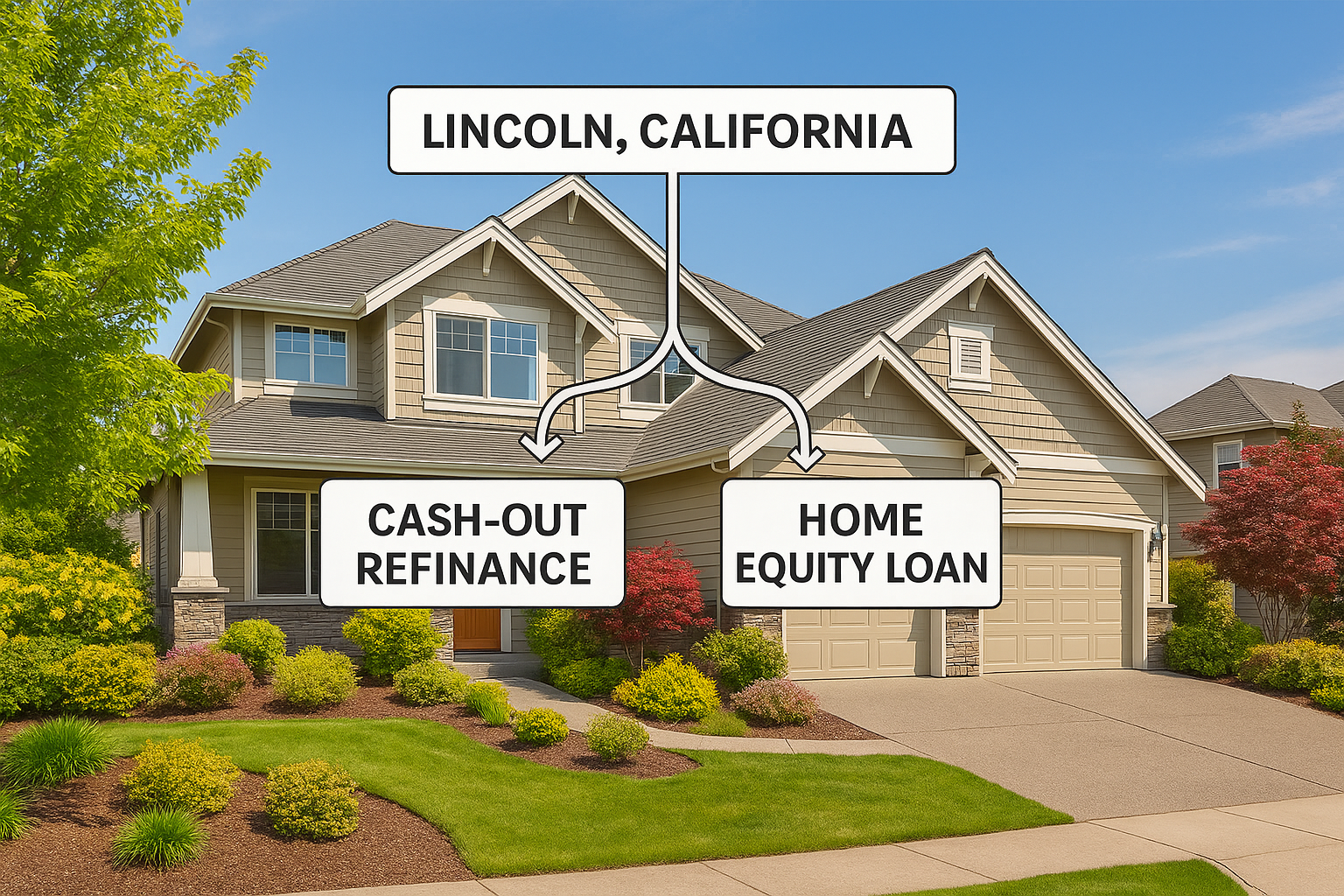
When homeowners in Lincoln, CA consider tapping into their home equity, they’re often torn between two common options: cash-out refinancing and home equity loans. Both strategies can provide access to funds for large expenses, but they operate in distinct ways and are suitable for different financial situations. Understanding their differences, pros and cons, and how they interact with Lincoln’s real estate market is crucial to making the right decision.
Understanding Home Equity
Home equity is the difference between your home’s current market value and the outstanding balance of your mortgage. In Lincoln, CA, where home values have steadily increased, many homeowners now possess significant untapped equity.
For example, if your home is worth $600,000 and you owe $350,000 on your mortgage, your equity is $250,000.
What Is a Cash-Out Refinance?
A cash-out refinance involves replacing your existing mortgage with a new, larger one. The difference between the two loans is given to you in cash. You can use this money for renovations, debt consolidation, or any other major financial need.
- Replaces current mortgage
- New loan typically has different terms (rate, duration)
- You receive the “cashed out” difference as a lump sum
What Is a Home Equity Loan?
A home equity loan is a second mortgage based on the equity you’ve built in your home. You keep your current mortgage and take out a new loan for a specific amount, typically at a fixed interest rate.
- Keeps original mortgage intact
- Fixed interest rate and repayment schedule
- Lump sum disbursed upfront
Pros and Cons of Cash-Out Refinancing
Pros:
- May secure a lower interest rate on the entire loan (if rates have dropped)
- Potential to consolidate multiple debts at a lower rate
- Single monthly mortgage payment
Cons:
- Closing costs can be higher than home equity loans
- Resets the mortgage term (could extend payoff date)
- Risk of losing a favorable original mortgage rate
Pros and Cons of Home Equity Loans
Pros:
- Keeps existing mortgage unchanged
- Fixed rate offers predictable payments
- Good option if your current mortgage rate is lower than today’s market
Cons:
- Typically higher interest rate than a primary mortgage
- Second mortgage means two payments
- Loan amounts may be smaller
Key Differences: Cash-Out Refi vs. Home Equity Loan
| Feature | Cash-Out Refinance | Home Equity Loan |
|---|---|---|
| Replaces Mortgage? | Yes | No |
| Interest Rate | Usually lower | Typically higher |
| Loan Type | Primary mortgage | Second mortgage |
| Closing Costs | Higher | Lower |
| Best When | Mortgage rates are low | You already have a low mortgage rate |
Lincoln, CA Housing Market Overview
As of 2025, the median home value in Lincoln is approximately $580,000, with steady appreciation year over year. The city’s growth, access to Sacramento, and suburban charm make it a desirable place to live.
Implications: With rising values, homeowners in Lincoln often have substantial equity, making either strategy a viable funding option.
Which Option Is Best for Lincoln Homeowners?
If your current mortgage rate is higher than today’s rates, a cash-out refinance may save you money long-term. But if you’re locked into a low rate from a few years ago, a home equity loan avoids disrupting that benefit.
In Lincoln’s market:
- Cash-out refinancing may suit newer buyers who purchased at higher rates.
- Home equity loans may benefit long-term residents who bought when rates were historically low.
Local Lenders and Requirements in Lincoln
Popular lenders in Lincoln, CA offering both products include:
- Fairway Independent Mortgage Corp
- Golden 1 Credit Union
- U.S. Bank and Wells Fargo local branches
Typical Requirements:
- 620+ credit score
- 15-20% equity
- Stable income and DTI under 43%
When to Use Each Strategy
Use a Cash-Out Refinance If:
- You want to refinance into a better rate anyway
- You need a large sum of money
- You prefer one monthly payment
Use a Home Equity Loan If:
- You want to preserve your low current mortgage rate
- You need funds for a single project
- You want predictable payments
Real-World Example: Lincoln Homeowner Case Study
Scenario: John and Maria bought a Lincoln home in 2018 for $450,000 with a 3.25% interest rate. Their home is now worth $600,000, and they owe $350,000. They want $50,000 for remodeling.
Best Option: Home equity loan because they preserve their low mortgage rate and only borrow what they need.
Alternate Scenario: Dave bought in 2021 with a 6.75% mortgage. With rates now around 5.5%, he could refinance, pull out $75,000, and lower his monthly payments.
Best Option: Cash-out refinance because it lowers rate and provides cash.
Final Decision Guide: 5-Point Checklist
- What’s your current mortgage rate?
- Do you want to refinance your first mortgage?
- How much equity do you have?
- How much money do you need?
- Can you handle two monthly payments?
Tax Implications of Home Equity Financing
While proceeds from a home equity loan or cash-out refinance aren’t taxed as income, the interest may or may not be deductible. The IRS allows deductions only if the funds are used to “buy, build, or substantially improve” the taxpayer’s home that secures the loan.
Lincoln homeowners considering remodeling projects could benefit from this deduction. But if you’re using funds for unrelated purposes like paying off credit cards, the interest is not deductible.
Consult a tax professional to understand the implications specific to your situation.
Interest Rate Trends in 2025 and How They Affect Your Choice
Interest rates in 2025 are slowly declining after a peak in 2023. The average 30-year fixed rate hovers around 5.5%, compared to highs of 7%+ just two years ago.
This trend favors cash-out refinancing, especially if you secured your mortgage at a higher rate. However, those with ultra-low rates (below 4%) from pre-2022 may still benefit more from a home equity loan.
Staying informed on rate trends helps time your financing decisions optimally.
Renovation Projects That Deliver ROI in Lincoln Homes
If you’re using equity to improve your home, focus on upgrades with strong return on investment (ROI):
- Kitchen remodels
- Bathroom updates
- Energy-efficient windows
- Solar panel installation
- Landscaping and curb appeal
Lincoln’s suburban appeal means family-friendly features and energy savings are particularly valuable. These projects not only improve your quality of life but can also increase your home’s resale value.
How to Calculate Your Borrowing Power
Most lenders allow you to borrow up to 80% of your home’s value minus your mortgage balance.
Formula:
(Home Value x 0.80) – Existing Mortgage = Max Loan Amount
Example:
- Home value: $600,000
- Mortgage balance: $350,000
- Max borrowing: ($600,000 x 0.80) – $350,000 = $130,000
Knowing this number helps set realistic expectations before you apply.
Credit Score Impact and Loan Eligibility
Credit score plays a critical role in qualifying and securing favorable rates. Generally:
- 620: minimum requirement
- 700+: ideal for best rates
Improving your score before applying, by paying down debt and avoiding new credit inquiries, can save you thousands over the life of your loan.
Both loan types require strong documentation of income, employment, and assets.
Avoiding Equity Loan Scams and Predatory Lenders
Unfortunately, some lenders target homeowners with misleading offers or hidden fees. Warning signs include:
- High-pressure sales tactics
- Unusually high fees or prepayment penalties
- Promises of guaranteed approval without documentation
Stick to reputable local lenders in Lincoln like Fairway, Golden 1, or trusted banks. Always read the fine print and ask for a full Loan Estimate.
The Application Process: What Lincoln Borrowers Need to Know
Expect a multi-step process that includes:
- Pre-qualification (optional)
- Full application with documentation
- Home appraisal
- Underwriting and approval
- Loan closing and disbursement
Timeline ranges from 2 to 6 weeks, depending on lender speed and appraisal scheduling. Choose lenders with a local presence for faster, smoother processing.
Expert Tips from Local Mortgage Professionals
- “Start with your goals — not just the loan type,” says Mike Swaleh of Fairway Mortgage.
- “If your current rate is under 4%, don’t refinance unless you absolutely must.”
- “Equity can be powerful — but it’s not free money. Plan how you’ll use it.”
Local experts understand Lincoln’s market and can tailor guidance to your exact financial profile.
Tools and Calculators for Home Equity Decisions
Several free online tools can help you model scenarios:
- Mortgage refinance calculators
- Home equity loan estimators
- Amortization schedules
Use these before meeting with a lender so you’re informed and empowered.
Conclusion
For homeowners in Lincoln, CA, choosing between a cash-out refinance and a home equity loan comes down to your mortgage rate, financial goals, and how much cash you need. Each tool has its advantages and understanding their differences in the context of your unique situation is the key to unlocking your home’s value wisely.
Whether you’re looking to remodel, consolidate debt, or invest, the right strategy will help you achieve your goals while preserving your long-term financial health.
FAQs
Is cash-out refinancing a good idea in Lincoln, CA right now?
Yes, especially if your current mortgage rate is higher than today’s market rates. A cash-out refinance lets you tap equity while lowering your rate.
How much can I borrow with a home equity loan in Lincoln?
Most lenders allow you to borrow up to 80–85% of your home’s value minus your current mortgage balance.
Do I pay taxes on the money I get from a home equity loan or cash-out refinance?
Generally, no. These are loan proceeds, not income. However, consult your tax advisor for details on deductions.
Which has lower closing costs: cash-out refinance or home equity loan?
Home equity loans typically have lower closing costs since they don’t replace your entire mortgage.
What’s better if I need a small amount of money — like $25,000?
A home equity loan is often better for smaller sums, especially if your existing mortgage has a favorable rate.


