

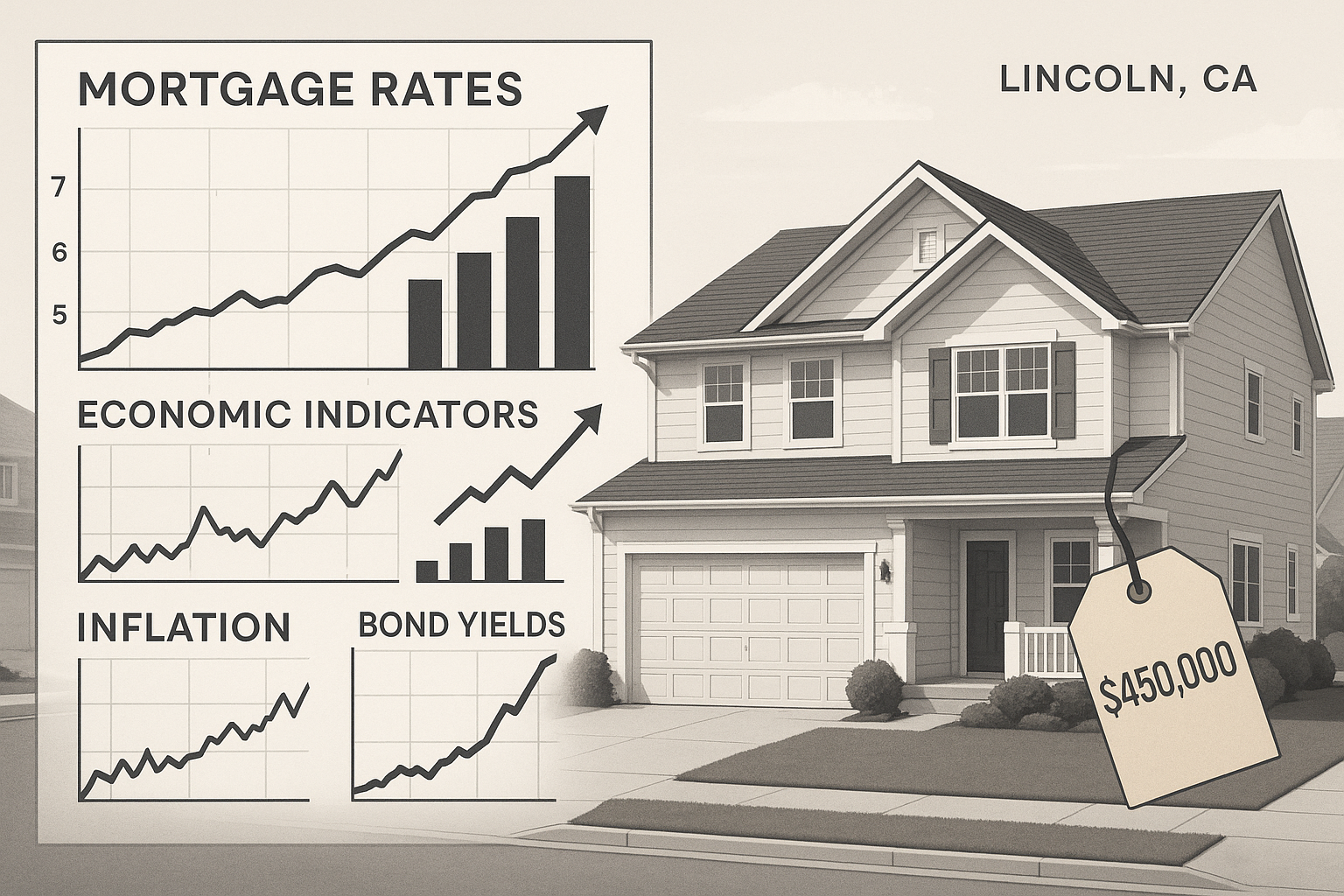
If you’ve ever applied for a mortgage and wondered why your interest rate was what it was, then you’re not alone. For homebuyers in Lincoln, CA, understanding how mortgage rates are set can feel like cracking a secret code. This guide demystifies the process and gives you a behind-the-scenes look at the moving parts that affect what you pay over the life of your home loan.
What Influences Mortgage Rates Nationally
Mortgage rates are influenced by both broad economic trends and individual lender strategies. At a national level, here are the key influencers:
- Bond Market (10-year Treasury yields): Mortgage rates typically move in tandem with the 10-year U.S. Treasury yield. When yields rise, mortgage rates generally do too.
- Inflation: Higher inflation erodes purchasing power and typically leads to higher interest rates.
- Employment Data: Strong job reports can push rates higher, while weak ones may lead to lower rates.
- GDP Growth: Fast economic growth often means rising rates.
The Role of the Federal Reserve
Despite common belief, the Federal Reserve does not set mortgage rates directly. However, it heavily influences them.
- When the Fed adjusts the federal funds rate, it indirectly affects short-term rates and the broader economy.
- The Fed also buys or sells mortgage-backed securities (MBS), impacting supply and demand, which can move rates up or down.
Economic Indicators That Affect Rates
Lenders monitor a wide range of reports and indicators, including:
- Consumer Price Index (CPI) and Producer Price Index (PPI) for inflation trends
- Jobs reports and unemployment rates
- Retail sales, housing starts, and manufacturing data
These reports help forecast risk and demand, guiding mortgage pricing strategies.
Lender Pricing: The Hidden Formula
Each mortgage lender, including those in Lincoln, CA, has their own pricing strategy. Here’s what happens behind the scenes:
- Cost of Funds: Lenders borrow money too, and their costs influence what rates they must charge.
- Profit Margin Goals: Each lender bakes in margins to stay profitable.
- Risk-Based Pricing: Riskier loans (due to credit, income, or property type) are priced higher.
- Operational Costs: Local competition, staffing, and marketing overhead all influence final rate quotes.
How Borrower Profiles Influence Rates
Your personal financial profile is a major determinant of your rate:
- Credit Score: Higher scores generally yield better rates.
- Down Payment: More money down can reduce risk and improve pricing.
- Loan Type: FHA, VA, USDA, and conventional loans all carry different rate structures.
- Debt-to-Income Ratio (DTI): Lower DTI signals stability, often earning a better rate.
- Property Type: Primary residences often get lower rates than investment properties.
The Local Factor: Why Lincoln, CA Mortgage Rates Vary
Mortgage rates can vary based on local market conditions. Here’s how Lincoln, CA makes an impact:
- Home Price Trends: Stability or volatility in local home values affects perceived risk.
- Housing Inventory: More homes on the market may drive rates slightly lower due to competition.
- Local Economic Health: Employment rates, growth industries, and median income levels shape rate decisions for local borrowers.
- Lender Competition: In Lincoln, multiple lenders vying for market share may offer promotional rates or discounts.
If you’re shopping for homes in Lincoln, CA, it’s crucial to work with a local expert who understands these nuanced differences and not just a national algorithm.
Fixed vs. Adjustable Rates: How They’re Priced
There are two primary rate structures:
- Fixed-Rate Mortgages (FRMs): These are tied closely to the bond market and offer long-term predictability.
- Adjustable-Rate Mortgages (ARMs): Initial rates may be lower, but they’re based on short-term indexes like the LIBOR or SOFR, and they can fluctuate.
Lenders price ARMs more aggressively when they expect short-term rate stability or cuts from the Fed. These can be a good option if you know the risks.
Rate Locks: Timing Your Mortgage Strategically
A rate lock protects you from rising rates while you shop or finalize your loan. But it’s not just a button you press. It’s a strategy.
- Locks typically last 30–60 days
- Extensions may cost more
- Floating the rate is a gamble and rates could drop or spike
In a volatile market, a lock could save you thousands or cost you a better deal if timed poorly.
How Mike Swaleh Helps Lincoln Buyers Navigate Rates
As a seasoned loan officer in Lincoln, CA, Mike Swaleh doesn’t just quote rates — he crafts a strategy:
- Reviews national trends and local market conditions
- Considers your full borrower profile and not just your credit score
- Compares programs like FHA, VA, and USDA to identify the best rate structure
- Offers personalized advice on when to lock, what to expect, and how to negotiate fees
Working with a local mortgage expert like Mike means you’re not just accepting a rate. You’re optimizing your entire home financing approach.
Global Events and Geopolitics: How World News Affects Your Rate
From wars to pandemics and global financial instability, large-scale events can cause immediate shifts in bond markets, which in turn affect mortgage rates. For example, during times of global crisis, investors often flock to safer assets like U.S. Treasury bonds, which lowers yields and consequently mortgage rates. Conversely, global growth and investor confidence can lead to rising rates.
The Secondary Mortgage Market and Investor Influence
After a lender issues a mortgage, it often sells that loan on the secondary market to investors. These investors expect returns. If they demand higher yields, lenders must increase rates to remain competitive. Institutions like Fannie Mae and Freddie Mac play a key role here, and their policies affect rate structures.
How Mortgage-Backed Securities Impact Rates
Mortgage-backed securities (MBS) are bundles of home loans sold to investors. Their performance and demand directly influence mortgage rates. If MBS are seen as high-risk or underperforming, rates go up. When they’re strong and stable, rates typically fall.
The Yield Curve: What It Is and Why It Matters
The yield curve charts the interest rates of bonds across various terms. A normal curve indicates confidence and steady growth, while an inverted curve signals recession fears. Mortgage rates often follow these movements, making the yield curve a forecasting tool.
Comparing Bank vs. Non-Bank Lender Rates
Banks and non-bank lenders operate differently. Banks may offer more stable rates but with stricter requirements. Non-banks might take more risk, resulting in more flexible approvals but sometimes higher rates. In Lincoln, CA, understanding this can help you choose the right lender.
Seasonal Fluctuations: Are There Better Times to Get a Loan?
Mortgage rates often follow seasonal trends. Spring and summer, peak homebuying seasons, may see slightly higher rates due to demand. Fall and winter can offer rate dips. Lincoln buyers might strategically shop during these cooler seasons for better deals.
The Psychology of Mortgage Pricing: Behavioral Economics in Lending
Lenders aren’t just crunching numbers, they’re also gauging human behavior. Promotional rates, teaser loans, and psychological pricing (e.g., 6.99% instead of 7.00%) are all marketing tactics that influence borrower choices and lender strategies.
Why Online Rate Quotes Can Be Misleading
Clicking on a “today’s mortgage rates” ad can be deceiving. Many quotes are based on ideal borrower profiles and don’t account for credit issues, property types, or local nuances. Always speak to a trusted local loan officer for accurate information.
Jumbo Loans and Their Unique Rate Landscape
Jumbo loans, mortgages that exceed conforming loan limits, carry unique rate structures. They often come with higher risk, stricter underwriting, and slightly elevated rates, especially in markets like Lincoln with diverse property values.
How Discount Points Truly Affect Long-Term Costs
Buying mortgage points means paying upfront to lower your interest rate. One point usually equals 1% of the loan amount and reduces your rate by about 0.25%. Whether this is worth it depends on how long you plan to stay in the home. The longer you hold the mortgage, the more you can benefit from the reduced interest cost over time.
The Impact of Loan Term (15 vs. 30-Year Mortgages)
15-year loans typically have lower rates than 30-year loans because they present less risk and repay faster. However, they come with higher monthly payments. Knowing the trade-offs helps Lincoln buyers choose smartly, especially if they have steady income and want to save on total interest paid.
How Technology and AI Are Changing Rate Decisions
Today’s lenders use sophisticated algorithms to assess risk and set pricing in real-time. Artificial intelligence can analyze thousands of variables instantly, from credit history to market volatility, making mortgage rates more responsive to microtrends and borrower behavior than ever before. Fintech advancements also enable faster pre-approvals and more personalized rate offers.
The Role of Mortgage Insurance in Pricing
Private mortgage insurance (PMI) is required for many low-down-payment loans. It adds cost to the loan and in some cases, affects the interest rate quoted. Borrowers with less than 20% down should factor in both the added monthly PMI and the potential rate adjustment. Knowing when and how PMI applies helps calculate the true cost of a mortgage.
How Appraisal Gaps Can Influence Final Rates
If your home appraisal comes in lower than the purchase price, you may have to pay the difference or renegotiate. This affects your loan-to-value (LTV) ratio which is a critical factor in rate calculation. A higher LTV usually means a higher rate. Appraisal issues are common in fast-moving markets like Lincoln, and preparing for them in advance is key.
The Truth About Mortgage Rate Advertising
Not all advertised rates are real. Many are based on perfect borrower scenarios (e.g., 800+ credit, 20% down, no PMI) and don’t reflect closing costs or market fluctuations. Always read the fine print and consult with a reputable, transparent lender. A rate quote should be personalized, not plucked from an ad.
How Green Home Features May Lower Your Mortgage Rate
Energy-efficient homes may qualify for green mortgage programs that offer better rates or incentives. Features like solar panels, Energy Star-rated appliances, smart thermostats, and upgraded insulation can reduce long-term costs for both borrower and lender, making them less risky and more attractive. Ask your lender about Energy-Efficient Mortgages (EEMs).
Case Study: Two Buyers, Same House, Different Rates
Consider this scenario: Buyer A and Buyer B apply for the same home in Lincoln.
- Buyer A: 780 credit score, 20% down, stable job history, low DTI
- Buyer B: 650 credit score, 5% down, self-employed, moderate DTI
Even though it’s the same property and the same sale price, Buyer B’s risk profile leads to a mortgage rate nearly 1% higher than Buyer A’s. This can amount to tens of thousands of dollars over the life of the loan which is a powerful lesson in financial preparation.
Preparing Financially to Qualify for the Best Rate
To secure the lowest rate possible, homebuyers should begin preparing months in advance. Key steps include:
- Improve your credit score (pay down debt, check reports, avoid new inquiries)
- Save for a larger down payment (ideally 20% to avoid PMI)
- Lower your debt-to-income ratio
- Document your income thoroughly, especially if self-employed
Proactive planning gives you leverage when it comes time to lock a rate.
Final Thoughts: From Rate Awareness to Rate Advantage
Understanding the mechanics of mortgage rate setting empowers you to make strategic choices, from timing your application to selecting the right loan structure. In a dynamic market like Lincoln, CA, knowledge isn’t just helpful, it’s profitable. Partnering with a trusted local lender ensures you stay ahead of the curve and avoid costly mistakes.
FAQs
What determines mortgage interest rates?
Mortgage rates are influenced by bond markets, inflation, the Federal Reserve, lender profit margins, and borrower financial profiles.
Why do mortgage rates vary by location?
Local economic conditions, housing inventory, and lender competition can all impact mortgage rates in specific areas like Lincoln, CA.
Is it better to lock a mortgage rate or float?
Locking protects you from rising rates but may prevent you from benefiting if rates drop. A local expert can help you time this decision smartly.
Do all lenders offer the same mortgage rate?
No. Each lender has different risk models, overhead costs, and rate strategies — making comparison shopping essential.


