

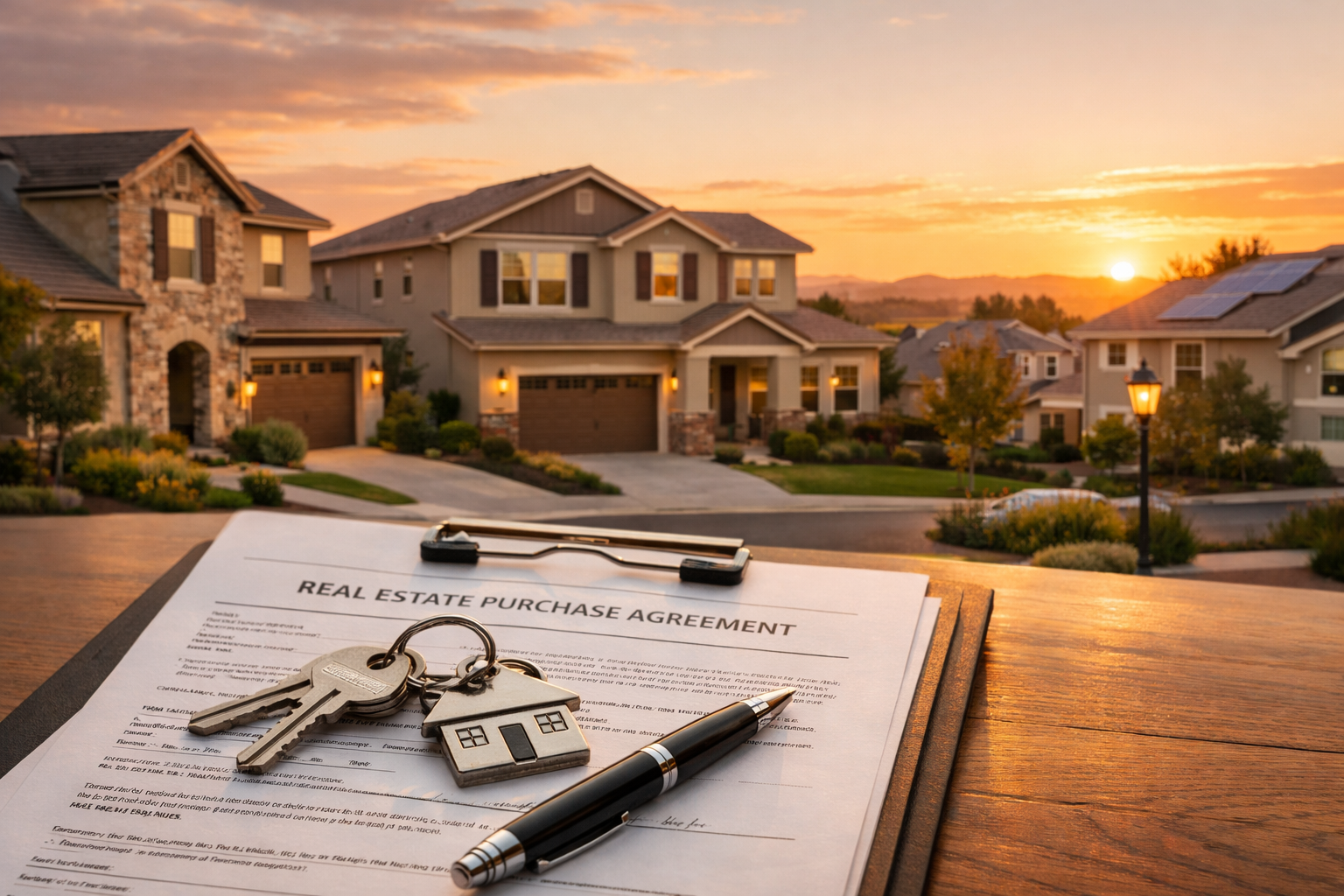
Buying a home in Lincoln, CA is one of the biggest financial moves most families will ever make. You save for a down payment. You improve your credit. You get pre-approved. You shop carefully.
And then you see the final number needed to close.
Between lender fees, title charges, prepaid taxes, and insurance, buyers are often surprised by how much cash they must bring to the table on top of their down payment.
That’s where seller concessions can change the game.
In this complete 2026 guide, we’ll break down exactly how seller concessions work in Lincoln, CA, how much you can ask for, what loan programs allow, and how to structure your offer strategically to reduce closing costs without jeopardizing your approval.
What Are Seller Concessions?
Seller concessions are credits the seller agrees to pay toward a buyer’s closing costs.
Instead of lowering the home’s purchase price, the seller contributes money at closing that reduces how much the buyer must bring in cash.
Think of it like this:
- A price reduction lowers your loan amount slightly.
- A seller concession lowers your upfront cash requirement.
For many buyers in Lincoln, that difference is critical.
If your closing costs are $18,000 and the seller agrees to cover them, that’s $18,000 you don’t have to drain from your savings account.
Why Seller Concessions Matter in Lincoln, CA
Lincoln has grown significantly over the past decade. With newer communities, expanding amenities, and strong commuter access to Sacramento and Roseville, home prices reflect demand.
In higher price ranges, even a small percentage in closing costs equals thousands of dollars.
For example:
- $650,000 home
- 2.5% in closing costs = $16,250
That’s not pocket change.
Preserving that money can mean:
- Keeping a stronger emergency fund
- Furnishing your new home comfortably
- Avoiding high-interest credit card use
- Maintaining financial flexibility
Seller concessions allow buyers to stay liquid instead of stretching thin.
What Closing Costs Do Buyers Pay in Placer County?
Most Lincoln buyers pay between 2% and 3% of the purchase price in closing costs.
These typically include:
- Loan origination fees
- Underwriting fees
- Appraisal fees
- Credit report
- Title insurance
- Escrow services
- Recording fees
- Prepaid property taxes
- Prepaid homeowner’s insurance
- Initial escrow impounds
On a $700,000 purchase:
- 2% = $14,000
- 3% = $21,000
That is in addition to your down payment.
What Seller Concessions Can and Cannot Cover
Seller concessions can cover:
- Lender fees
- Discount points
- Appraisal
- Title and escrow
- Prepaid taxes and insurance
- HOA transfer fees (if applicable)
Seller concessions cannot cover:
- Your down payment
- Reserve requirements
- Costs exceeding program limits
If you request more than the loan program allows, the excess simply cannot be applied.
That’s why structuring correctly matters. To know more about this, you can talk to Mike Swaleh for guidance.
Seller Concession Limits by Loan Type
Every loan program sets limits on how much a seller can contribute.
Conventional Loans
For primary residences:
- Less than 10% down → Up to 3% seller concession
- 10%–25% down → Up to 6%
- Over 25% down → Up to 9%
Example:
$675,000 home
5% down payment
Max seller concession = 3% = $20,250
If your closing costs are $17,000, they can be fully covered.
FHA Loans
FHA allows up to 6% of the purchase price in seller concessions.
On a $600,000 home:
6% = $36,000 maximum allowable credit.
That flexibility makes FHA attractive for buyers who need help covering upfront expenses.
VA Loans
VA loans allow up to 4% in seller concessions, plus certain allowable closing costs.
Because VA loans require no down payment, seller concessions can dramatically reduce total cash needed.
For eligible veterans in Lincoln, this can mean closing with very little out-of-pocket.
USDA Loans
USDA allows up to 6% seller concessions.
Eligibility depends on property location and income caps, but certain surrounding areas near Lincoln may qualify.
How Much Are Closing Costs in Lincoln, CA? (Real Numbers)
Let’s break down a realistic example.
Home price: $685,000
Loan type: Conventional
Down payment: 5% = $34,250
Estimated closing costs: $18,500
Without concessions:
Cash to close = $52,750
With 3% seller concession (max allowed = $20,550):
Closing costs fully covered.
New cash to close = $34,250
Savings upfront = $18,500
That’s nearly a full year of mortgage payments preserved in liquidity.
Detailed Scenario Breakdowns
Scenario 1: First-Time Buyer Using FHA
Purchase price: $620,000
Down payment (3.5%): $21,700
Closing costs: $17,000
Seller concession requested: $17,000
Allowed under FHA? Yes, well under 6% cap ($37,200 max)
Result:
Buyer closes with approximately $21,700 plus minimal additional fees.
Scenario 2: Buyer in Competitive Market
Purchase price: $700,000
Closing costs: $19,000
Buyer increases offer to $715,000 with $19,000 seller concession.
If property appraises at $715,000:
Deal works.
If appraisal comes in at $700,000:
Lender finances based on $700,000.
Buyer must renegotiate or bring additional cash.
This is why appraisal strategy matters.
Seller Concessions vs. Price Reductions
Let’s compare long-term math.
Option A: $15,000 Price Reduction
Loan decreases by $15,000.
Monthly payment drops approximately $90–$110.
Over 5 years, savings = roughly $6,000.
Option B: $15,000 Seller Concession
Immediate savings = $15,000 at closing.
For buyers tight on liquidity, concessions often provide more meaningful impact.
Price reductions help long-term.
Concessions help immediately.
Which matters more depends on your situation.
Appraisal Risks When Using Seller Credits
One common mistake is inflating the purchase price to “bake in” concessions.
Lenders base loans on the lower of:
- Purchase price
- Appraised value
If the appraisal falls short, financing gaps appear.
In Lincoln’s mid-to-upper price ranges, appraisals must be supported by comparable sales.
Structuring intelligently avoids surprises.
When Are Seller Concessions Easier to Negotiate?
Seller concessions are more likely when:
- Homes sit on market 30+ days
- Inventory rises
- Interest rates are elevated
- Sellers already purchased another property
- Multiple price reductions occurred
They’re harder to obtain during:
- Bidding wars
- Low inventory periods
- Multiple-offer situations
Market timing plays a major role.
Advanced Negotiation Strategies for 2026
- Request concessions instead of repairs.
Sellers often prefer credits over managing contractors. - Use inspection findings strategically.
Condition issues can justify credits. - Align with seller motivation.
Relocation sellers may value speed over price. - Structure clean terms.
Fewer contingencies strengthen concession requests. - Consider partial concessions.
Even $7,500 or $10,000 can meaningfully reduce costs.
Market-Specific Considerations in Lincoln, CA
Lincoln features:
- Newer master-planned communities
- HOA-managed neighborhoods
- Higher median home values compared to some nearby areas
In new construction, builders may offer closing cost incentives instead of price cuts.
In resale markets, concessions often follow longer days on market.
Understanding micro-market conditions inside Lincoln neighborhoods improves negotiation success.
Common Buyer Mistakes to Avoid
Mistake #1: Asking above program limits
Mistake #2: Forgetting appraisal risk
Mistake #3: Confusing concessions with down payment assistance
Mistake #4: Failing to write concessions into the purchase contract
Mistake #5: Draining savings by not negotiating at all
Long-Term Financial Impact of Preserving Cash
Keeping $15,000–$20,000 in reserves matters.
It can:
- Cover unexpected repairs
- Protect against job interruptions
- Prevent high-interest borrowing
- Fund home improvements
- Maintain financial peace of mind
Homeownership should not feel financially suffocating.
Seller concessions help buyers transition into ownership with stability.
Final Takeaways for Lincoln Homebuyers
Seller concessions are one of the most powerful, and most misunderstood, tools available to buyers in Lincoln, CA.
When used properly, they can:
- Eliminate closing costs
- Preserve savings
- Improve financial security
- Make higher-priced homes more attainable
But structure matters.
Loan limits matter.
Appraisals matter.
Market timing matters.
A well-planned strategy can mean the difference between barely making it to closing and moving in with confidence.
FAQs
How much can a seller contribute to closing costs in Lincoln, CA?
It depends on the loan type. Conventional loans typically allow 3–9%, FHA allows 6%, and VA allows 4% plus allowable costs.
Do seller concessions increase your mortgage payment?
Only if you increase the purchase price to offset them. Otherwise, they reduce upfront cash without affecting payments.
Are seller concessions common in Lincoln, CA?
They are more common in balanced or slower markets and less common during competitive bidding situations.
Can seller concessions cover my down payment?
No. They can only cover allowable closing costs, not your down payment.
Is it better to ask for a price reduction or seller concessions?
If you need upfront savings, concessions usually provide more immediate financial benefit.


